


Why Christian Education?
This movement of Christian schools is gaining momentum around the world, including in the French-speaking world. It can raise questions. Here are some of our thoughts, which we hope will provide answers.

Videos


Le principe de laïcité n'est-il pas menacé ?
Since the creation of evangelical Protestant schools, this question has been asked to us regularly, and it is up to us to answer it to the extent that most of them are rich in constructive questioning and constitute “blinking signs”.
Without ambiguity, we affirm that it is on the contrary confirmed by this initiative and re-specified. Secularism must above all be a protection of plural beliefs and not a sectarian and aggressive expression.
Would it be desirable to seek to erase all forms of transcendence from education? Is there a neutral education?
The Christian school is one of the bodies that can contribute to the ethical debate, which is particularly mobilizing in this period of worrying contradictions.
Is it not appropriate in our time to articulate standards, values, convictions to establish the meaning of any individual and collective project?
Our country must favor the sources of secularism that guarantee social bonds, nourished by tolerance, freedom and responsible commitment. The legal framework to which our schools necessarily refer and in particular article 18 of the Universal Declaration of Human Rights invites us to do so, as well as article 9 of the European Convention on Human Rights and Fundamental Freedoms of November 4, 1950.
The responsible citizenship that the French education system wishes to develop, certainly comes from humanity, from respect for the person, individually or socially considered: we can only share this orientation. However, Christian convictions exclude the possibility that humans have their own consistency and can ignore faith in Christ and the reception of His grace: the construction of a specific educational trajectory is based on a certain conception of man, a keen eye on order, the coherence of socio-cultural dynamics and an absolute priority given to LIFE.
However, it is not a question of fearing indoctrination or manipulation, precisely because of the valued principle of secularism, which underlies the responsibility for everyone to engage in their thoughts and actions and invites the educator to develop the capacity for reflection, judgment and choice.
A comment by René Voeltzel, professor at the Protestant theology faculty of Strasbourg, taken from the journal “faith and education” – July 1949:
“Free” school
“…when we think of the capital importance attached by the Reformation in the 16th century to its schools and academies, we feel somewhat ashamed of the unconditional capitulation of the last quarter of the 19th century.
In defense of this point of view, we can say that it was difficult to suppose at the time that secularism would become secularism.
The free school, in our conception, is in no way pitted against secular school – as long as secularism remains correctly defined. (…)
Just as a parish which is content to ask its members to simply give their testimony in the world, without ever a solemn worship or a meeting of studies or prayer, would risk drying out, likewise, it is essential that Protestantism reserves a place where the school is defined as strictly Christian.
It would be as harmful to abandon all the young Protestants of France to the hypothetical testimony of a Christian professor in the secular school, as to pretend to lock up all these boys and girls in strictly closed catacombs.
Both schools must exist: this is what Catholics call pluralism – which is opposed to unity and monopoly.
It seems essential that, exceptionally, a few schools remain where Protestant Christians intend to take all their responsibilities.
We need this place of asylum, not for dunces and schizophrenics, but for normal children.
I am not saying that they will be the elite, nor that there is a superiority of the denominational school over the secular school, but this door must remain open, the experience must be constantly offered…”
Isn’t the Christian school a debilitating cocoon?
This observation concerns both character formation and cultural disconnect.
We will answer: “no”.
Christian education provides insight and the richness of the Word of God. Jesus trained his disciples on this basis.
To liberate the child's personality and not make him a slave to his individuality alone, the child must first know divine resources and learn to rely on them when he thinks, acts and testifies.
The school provides benchmarks, situations, relationships, at the same time as the distancing necessary to discover the essence of true strength: this does not reside in the power of an exaltation of the “me” which imposes its empire and makes the other captive, but it is born from an interior liberation developed by the direct relationship with God, His Truth, the sense of destiny expressed through a shared action which requires the acceptance of the other.
School is the place where we learn to think. If the educational process excludes God's point of view during schooling, it is a safe bet that the child is building himself on unstable and incoherent foundations. Our thoughts are the first place of the battle between darkness and light; However, only a formation of thought according to God generates obedience to Christ and provides daily reason, wisdom, intelligence and knowledge.
Furthermore, the experience of Christian schools forces us to think that the microcosm of these structures is not spared by a diversity of personal stories, experiences and points of view which confront children with a living questioning and rich in potential: we can then rejoice in replacing it according to a biblical vision of the world.
The question of Protestant schools
Loading Viewer...
School, a battleground between incompatible worldviews
Loading Viewer...
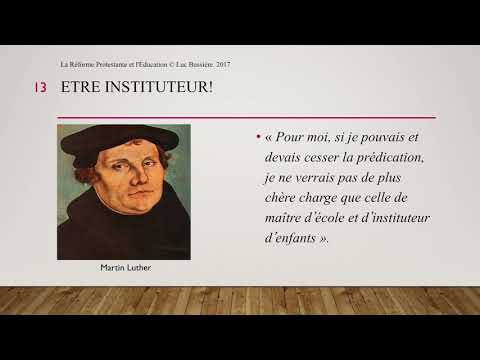
Luther, Calvin and the Protestant schools
Loading Viewer...
Protestant education, the path to freedom?
Loading Viewer...
Le droit à l'éducation
The Right to Education according to the European Court of Human Rights
Speech by Andrea Popescu, lawyer at the CEDJ, and former lawyer at the ECHR, during a conference organized by the EFD Group at the European Parliament in Brussels, on February 10, 2014, on the theme “Christian education in Europe”. Read the rest of the PDF document below.
Loading Viewer...
L'Europe et le christianisme

Resources in Spanish
Find in this category, two sermons in Spanish
1 – The Spirit of Elijah
2 – The vision of Christian schools. Preaching in Mexico